About 18 months ago, I commented on a LinkedIn discussion about the potential impact of Google’s AI Mode on news publishers.
The original post painted a fairly bleak picture of the future, arguing that AI Mode would accelerate the decline of publisher traffic, undermine the economics of online journalism and ultimately leave many publishers struggling to survive.
I agreed with much of the concern, but I had a slightly different perspective on how things might develop.
Rather than viewing AI Mode as an immediate end-of-days scenario, I suggested that Google would eventually have to find a middle ground between providing AI-generated answers and continuing to send users to the publishers responsible for producing the information.
I also made a few predictions about how that might happen.
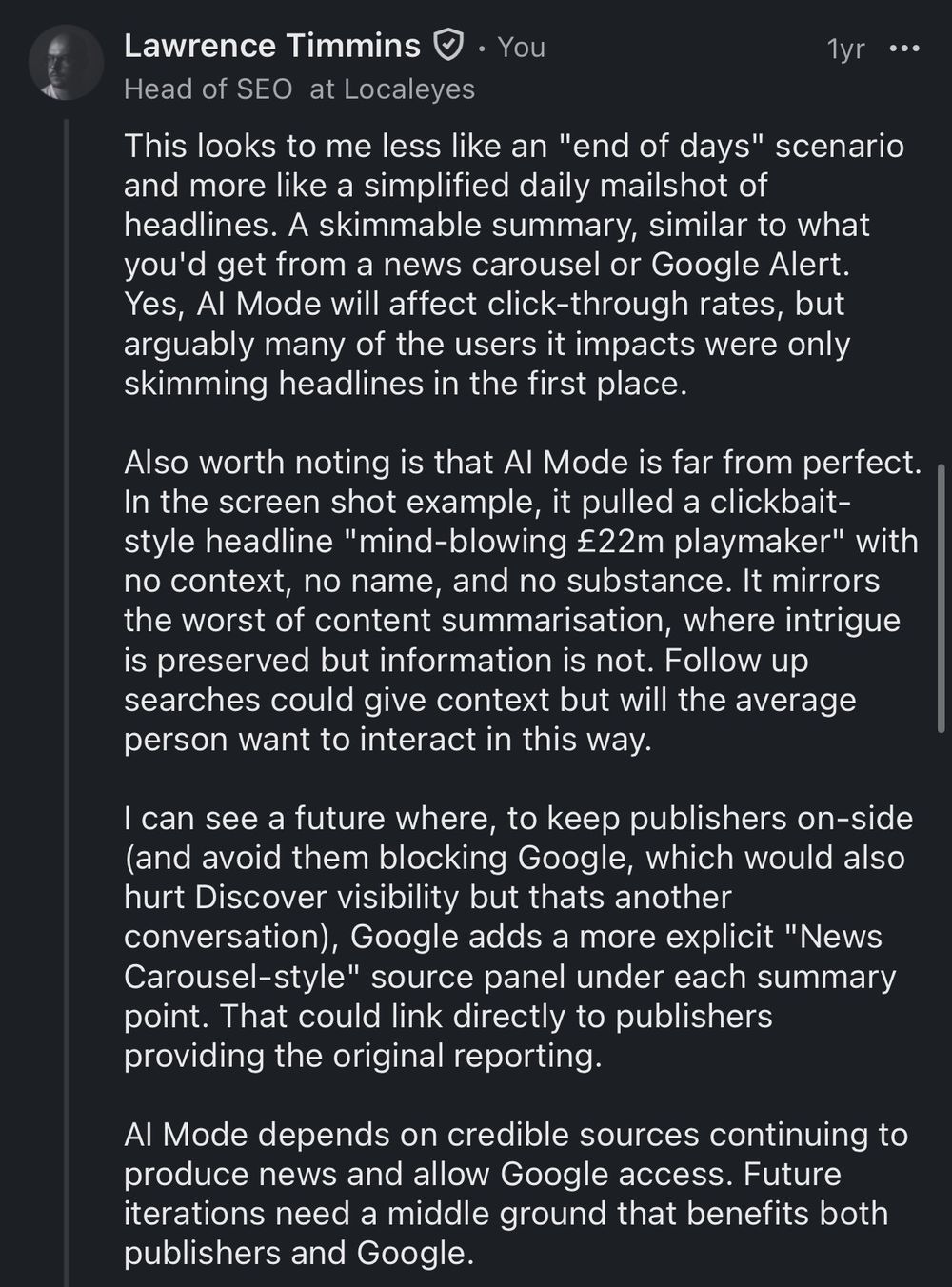
Looking back 18 months later, some of those predictions have become particularly interesting.
1. I predicted Google would introduce more prominent publisher links within AI responses
This was probably the most specific prediction I made.
At the time, I suggested that Google could introduce a more explicit, news carousel-style source panel underneath AI-generated summaries.
My thinking was relatively straightforward.
If Google wanted to keep publishers onside, it needed to do more than simply reference a collection of sources at the bottom of an AI-generated response.
It needed to make the original reporting more visible, accessible and clickable.
Fast forward to 2026, and Google has started doing exactly that.
Google introduced prominent article carousels for developing news topics within AI Overviews, before subsequently bringing similar functionality into AI Mode.
These carousels display article headlines, images, publisher names and publication dates, giving users a much clearer route to the original reporting.
In October 2026, Google announced further expansion of these features, alongside more prominent inline links and related article recommendations.
It’s not quite the exact interface I described, but the underlying principle is remarkably similar.
Google has recognised that AI-generated summaries need to provide more meaningful connections to the publishers producing the original content.
2. The problem isn’t necessarily consuming information. It’s monetising it.
One of the points I made in my original comment was that AI Mode would undoubtedly affect click-through rates, but that some of the people affected might previously have been doing little more than skimming headlines.
I compared the experience to a daily mailshot of headlines, Google Alerts or a news carousel.
There is an important distinction here.
Not everyone who sees a news headline on Google intends to visit the publisher’s website.
Some people simply want to know what happened, understand the basic context and move on.
AI Mode makes that experience considerably easier.
The problem for publishers is that Google can potentially satisfy the user’s information needs without generating a visit to the website that produced the information.
And that creates a fundamental commercial problem.
A user can consume the journalism without generating an advertising impression, a subscription opportunity or any meaningful direct commercial value for the publisher.
Research published in 2026 has provided further evidence of this issue.
A preprint study published in August 2026, based on a randomised experiment involving 1,100 Google users, found that an AI Mode-only search experience reduced click-through rates to external publishers and negatively affected several measures of user experience and trust.
Separately, Chartbeat data published by the Reuters Institute showed that Google search referrals to news publishers fell by a third globally in the year to November 2025, and by 38% in the US.
That decline cannot be attributed entirely to AI Mode or AI Overviews, but it illustrates the wider pressure facing publishers.
The distinction I was trying to make 18 months ago remains important: consuming information and visiting the source are two very different things.
3. I questioned whether people actually wanted to interact with AI to understand the news
Another part of my original comment concerned the quality of AI-generated news summaries.
I highlighted an example where Google’s AI Mode had surfaced a clickbait-style headline about a “mind-blowing £22m playmaker”, without providing the name of the player or meaningful context.
My argument was that it resembled the worst aspects of content summarisation: preserving intrigue while removing the information that actually matters.
I also questioned whether the average user would really want to undertake additional searches or follow-up conversations to establish the context behind an initially vague summary.
There’s a wider point here.
AI-generated answers can be technically impressive, but that doesn’t necessarily mean they are the best way to consume breaking news.
News is inherently time-sensitive. Context, attribution, nuance and the distinction between confirmed information and speculation all matter.
An answer that sounds convincing isn’t necessarily an answer that provides the reader with everything they need to know.
Google has since invested in making original reporting and timely articles more prominent within its AI search experiences.
That suggests the discovery element of AI-generated news is something Google continues to refine.
4. Google needs publishers more than it might initially appear
Perhaps the most important point I made was that AI Mode ultimately depends on credible sources continuing to produce content and allowing Google to access it.
Google’s AI products don’t exist in isolation.
They rely on an enormous ecosystem of websites, journalists, publishers, researchers and other content creators.
If that ecosystem becomes economically unsustainable, Google has a much bigger problem than simply losing a few search results.
It risks undermining the very information infrastructure that makes its AI answers useful.
In October 2026, Google announced that more than 400 publications worldwide were participating in its News AI pilot programme.
The programme involves payments to participating publishers for the delivery and use of enhanced content to develop new AI features.
Google says these experiences include clearer attribution and direct links to publishers.
This doesn’t mean Google has solved the commercial relationship between AI search and publishers. Nor does it mean every publisher whose content contributes to AI-generated answers is being compensated.
But it does demonstrate that Google is beginning to explore more formal commercial arrangements with the publishing industry.
18 months ago, I suggested that Google would eventually need to find a middle ground.
That conversation is now becoming a commercial reality.
5. What about the prediction that AI Mode would deliver half the clicks of Top Stories?
There was one particularly interesting response to my original comment.
Barry Adams suggested that, even in a best-case scenario, clicks to news stories from AI Mode would be around half of what publishers currently received from Top Stories.
It’s an interesting prediction, and one that deserves revisiting.
I haven’t seen sufficiently robust comparative data to establish whether that specific 50% estimate was accurate.
However, the wider direction of travel is difficult to ignore.
Google is increasingly integrating AI-generated answers into the search experience, while simultaneously making publisher links more prominent within those answers.
The important question is whether those improvements can generate enough additional clicks to compensate for the traffic lost through the introduction of AI-generated summaries.
More prominent links are welcome, but visibility doesn’t automatically translate into visits.
And visits don’t automatically translate into revenue.
So, was I right?
I wouldn’t claim to have predicted everything correctly.
The relationship between AI Overviews, Top Stories and AI Mode has evolved considerably. Google has experimented with different layouts, introduced new discovery features and started developing commercial arrangements with publishers.
Some of those developments were difficult to anticipate precisely.
But looking back at the original discussion, I think the central argument has held up particularly well.
I wasn’t suggesting that AI Mode wouldn’t hurt publishers. I was suggesting that Google would eventually have to make changes to the way it presented and attributed original reporting if it wanted to maintain a sustainable relationship with the publishing industry.
We’re now seeing evidence of that happening.
The bigger challenge for publishers, however, remains unresolved.
Google is simultaneously becoming a more effective destination for consuming information and a less reliable source of traffic to the websites producing it.
For publishers, that means the traditional relationship between search visibility, website visits and commercial value can no longer be taken for granted.
SEO isn’t disappearing, but the definition of search visibility is changing.
Being referenced by an AI answer, appearing in a news carousel, generating a traditional organic click and building a recognisable publisher brand are increasingly different things.
The publishers that adapt will need to think beyond simply ranking articles in Google.
They’ll need to build direct audiences, develop recognisable brands, diversify distribution and understand how their journalism is discovered and consumed across an increasingly fragmented search landscape.
The question I raised 18 months ago wasn’t whether Google would change. It was whether Google and publishers could find a way to benefit from the same ecosystem without one undermining the other.
That question is arguably more important today than it was when I first asked it.